
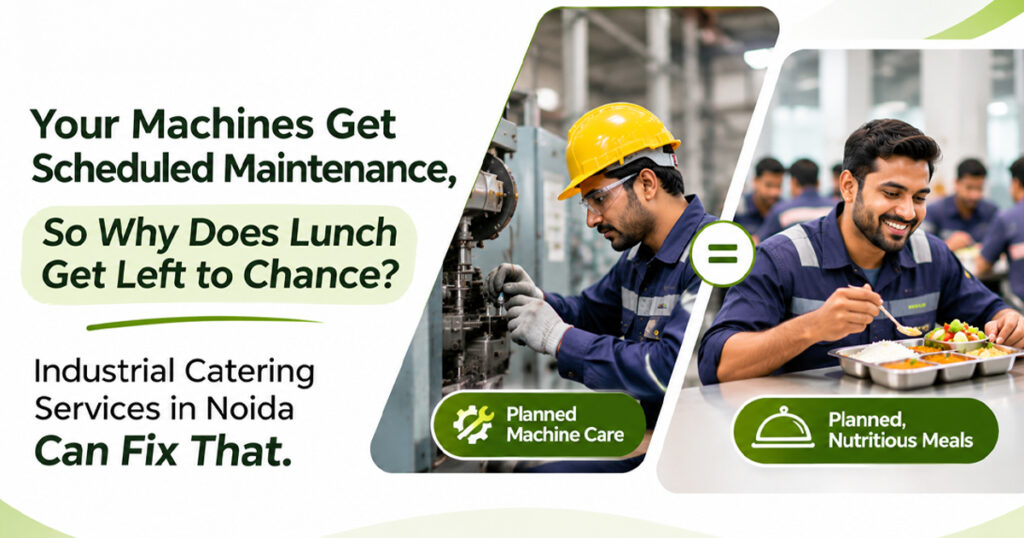
Think about how a well-run plant treats its machines. There’s a maintenance schedule. There are daily checklists, logs, spare parts, a named person responsible and a plan for when something breaks.
Now think about lunch. In many factories, it’s handled by a contractor who was found through a friend, a canteen that is cleaned “when someone remembers,” and a menu that hasn’t changed since the last Diwali. Nobody would run a CNC machine like that, yet hundreds of people eat from that kitchen every single day.
That gap is what good industrial catering services in Noida are meant to close. This guide looks at what they actually do, how to apply the same discipline to your canteen that you apply to your machines, and what to check before you sign a contract.
What do industrial catering services in Noida actually do?
Industrial catering means feeding a large workforce reliably, at fixed times, every day. It’s a different job from catering a party or a small office, because volume, timing and consistency matter more than presentation.
Depending on your site, it can include:
- Running the canteen on your premises, with cooking, serving and cleaning done in your kitchen
- Delivering bulk meals from the caterer’s central kitchen to your plant
- Shift meals, including breakfast, lunch, dinner and night-shift food
- Tea and snack service during breaks
- Meals for contract workers, supervisors, visitors and management, sometimes at different standards or menus
The model that suits you depends on your headcount, kitchen space, shift pattern and budget.
Why lunch can’t be left to chance
A factory break is short. If the queue is long, the food is late or the serving counter runs out of rice, the break is gone before people have eaten. That means a hungry, irritated shift returning to the line.
There’s also food safety. Cooking for hundreds of people means large batches, long holding times and a bigger consequence if something goes wrong. A single hygiene failure can affect many workers at once.
And there’s a plain human point. People who work physically demanding shifts deserve a meal that is clean, filling and on time. That’s not a perk. It’s basic respect.
Run the canteen like a maintenance plan
Here’s a useful way to think about it. Apply the logic you already use for equipment to your food service:
| Plant maintenance | Canteen equivalent |
|---|---|
| Preventive maintenance schedule | Daily cleaning, pest control and equipment checks on a fixed routine |
| Checklists and logs | Daily hygiene, temperature and stock records |
| Spare parts | Backup cook, backup gas supply and a backup vendor plan |
| Named person responsible | One accountable canteen manager who answers to you |
| Breakdown plan | A clear process if a delivery fails or an incident occurs |
| Periodic audit | Scheduled kitchen inspections and feedback reviews |
If your caterer can’t show you how they’d run each of these, you’re relying on luck.
What the law and licences generally expect
The Factories Act, 1948 empowers state governments to make rules requiring factories above a certain size, commonly more than 250 workers, to provide and maintain a canteen. In Uttar Pradesh, this is handled under the state’s factory rules, and canteen committees with worker representation are part of the picture in covered factories.
Separately, food businesses in India are expected to hold a valid FSSAI licence or registration, and you can ask your caterer to show it. Good caterers also keep medical fitness records for food handlers, follow pest control routines and maintain clean water and storage.
A caution: labour law in India has been changing, and requirements depend on your factory’s size and category. Confirm what applies to you with your compliance consultant or the relevant department. Also ask your finance team about the GST treatment of canteen costs, since it can be complicated.
Menus that suit a working shift
Industrial menus don’t need to be fancy. They need to be filling, balanced and varied enough that workers don’t tire of them. A typical lunch might include dal, a seasonal vegetable, a second dish, rice, rotis, salad and curd, with a rotating weekly plan.
A few practical points matter:
- Seasonal planning. Noida summers are hot, so lighter food, plenty of water and drinks such as buttermilk or lemon water are sensible. Winters allow heavier dishes.
- Cooking oil and salt. Workers eat these meals daily, so moderation matters.
- Special diets. Provide for vegetarian, Jain and other dietary needs where they apply.
- Dietitian input. If you want to be careful, ask a qualified dietitian to review the menu.
- Feedback. A simple suggestion register or worker committee helps the menu improve over time.
Shifts, timing and queues
Most industrial sites run more than one shift, and each has different needs. Breakfast for early starters, lunch at fixed windows, tea breaks, dinner and night-shift meals all need planning.
Queues are where service quietly fails. Ask how many serving counters there will be, how the flow works and whether service is staggered by department or shift. A well-designed canteen serves hundreds of people within a short break without chaos.
On-site kitchen or delivered meals?
Both work, but for different situations.
- On-site kitchen gives you fresher food, more menu control and flexible timing. It needs space, utilities, safety compliance and a larger caterer team.
- Delivered meals need less infrastructure on your side and suit smaller headcounts or sites without a kitchen. The trade-offs are transit time, temperature control and less flexibility.
If you’re not sure, a good provider will assess your site and suggest the better fit, rather than pushing whichever model suits them.
How contracts and pricing usually work
Pricing varies, so ask each provider to explain their model clearly. Two common approaches are a fixed rate per meal, and a cost-plus model where the caterer recovers actual costs and adds a management fee. Each has pros and cons. Fixed rates are easier to budget, while cost-plus can be more transparent if the records are open.
Whichever you choose, clarify:
- Who provides the kitchen, equipment, utilities and gas
- Minimum guaranteed meal counts, and what happens when headcount changes
- Price revision terms
- GST and any other charges
- Who pays for breakages, pest control and repairs
Ask for itemised quotes so you can compare providers fairly. Be cautious about rates that are far lower than the market, since quality, portion sizes or hygiene often pay for it.
How to choose industrial catering services in Noida
Look at the following before you decide:
- Experience at your scale. Ask for clients with similar headcounts and shift patterns.
- A site visit to another client’s canteen, ideally during service, to see how it really runs.
- FSSAI licence and hygiene practices, including how food handlers are trained and checked.
- Staffing and supervision. How many people will be on site, and who manages them?
- A backup plan for staff absence, equipment failure, gas shortages or supply problems.
- Insurance and incident handling. Ask how they’d respond if a food safety incident occurred.
- A transition plan, including a trial period and how they would take over from the existing vendor.
- References and reviews from plant managers or HR heads, not just a brochure.
Questions to ask industrial catering services in Noida before you sign
- How many workers do you currently serve, and in which kinds of plants?
- Who will be my day-to-day manager, and how do I reach them?
- What does your daily hygiene and cleaning routine look like, and can I see the records?
- How do you handle three shifts and night meals?
- What happens if your cook, vehicle or gas supply fails?
- How do workers give feedback, and what do you do with it?
- What are the price, contract term and exit conditions?
- How do you handle audits, inspections and compliance paperwork?
Mistakes that cause trouble later
- Choosing only on the lowest rate
- Not visiting an existing client’s canteen
- Leaving hygiene records to chance instead of reviewing them
- Signing a long contract without a trial period or a clear exit clause
- Ignoring worker feedback
- Having no backup plan for a bad day
- Not agreeing who is responsible for cleaning, pest control and repairs
How We Can Help
Coriander Corporate Catering provides professional industrial catering services in Noida and across Delhi NCR, serving factories, manufacturing units, warehouses, industrial parks, corporate offices and large workplaces.
Our services include on-site canteen operations, bulk meal preparation and delivery, daily workforce meals, cafeteria management, packed food services and customised catering solutions designed around your organisation’s requirements.
With the capacity to serve 15,000+ meals daily, we help businesses manage large-scale food requirements with planned menus, quality-focused food preparation and reliable catering operations.
Whether you need daily employee meals, industrial canteen management or catering for multiple shifts, Coriander offers customised food service solutions to support your workforce.
Looking for a reliable industrial catering partner in Noida? Contact Coriander to discuss your workforce size, meal requirements and catering needs.
Frequently asked questions
What are industrial catering services in Noida? They are catering services for factories and industrial sites, covering daily meals for large workforces, shift meals, tea service and sometimes full canteen operation inside the plant.
Is a canteen mandatory for factories? Under the Factories Act, 1948, state governments can require canteens in factories above a certain size, commonly more than 250 workers. Requirements depend on your factory and state rules, so confirm with your compliance consultant.
How much do industrial catering services in Noida cost? It depends on headcount, menu, shifts, who provides the kitchen and the contract model. Ask for an itemised written quote and compare like with like.
Can caterers handle night shifts? Many can, with planning. Ask about menus, timings and staffing for night service.
Do I need a licence for the caterer? Your caterer is expected to hold a valid FSSAI licence or registration, and it’s reasonable to ask to see it.
How do I know if the food is hygienic? Check the FSSAI licence, visit the kitchen, ask to see cleaning and temperature records, and talk to workers at a similar client site.
One last thought
You already know that machines run better with a plan, a schedule and someone accountable. The people who run those machines deserve the same. Choose industrial catering services in Noida providers that can show you their routines, not just their menus, and agree on checks, backups and feedback before the first meal is served. Then lunch stops being a matter of chance and becomes just another part of the plant that works.
This article is for general information. Legal requirements, licences and tax treatment vary by factory and state, so confirm details with your compliance consultant, the relevant authority and your finance team.